
Tarot Card Reading for Beginners: A Practical First Guide
Start your tarot card reading for beginners journey with clear card meanings, simple spreads, and ethical practices that build real confidence from day one.
Start my free readingPublished
Updated
15 min read
You've bought a tarot deck, opened the guidebook, and found yourself staring at a table full of illustrated cards with no idea where to begin. The temptation is to memorize every meaning immediately, search for a dramatic prediction, or keep drawing cards until one gives you the answer you want.
A calmer approach works better. Tarot card reading for beginners is a learnable practice built on structure, symbols, questions, and reflection. You don't need to be psychic, and you don't need to treat the cards as an unquestionable authority. Start with a small spread, observe carefully, write down your thoughts, and let skill develop through repetition.
Table of Contents
- What Tarot Actually Is Before the Mystery
- Understanding the Structure of a Tarot Deck
- Reading the Major Arcana as Life Patterns
- Forming a Clear Question and Choosing Your Spread
- Combining Cards Into One Coherent Reading
- Practicing Tarot Ethically and Avoiding Dependency
- Your First Seven Days of Tarot Practice
What Tarot Actually Is Before the Mystery
Hold a new deck in your hands and the first challenge usually isn't interpretation. It's orientation. You may recognize a few images, but you don't yet know how the cards relate to one another or what a reading is supposed to accomplish.
Tarot works well as a structured reflection tool. Each card presents images, patterns, characters, and symbolic tensions. A spread then gives each card a position, such as the past, present, challenge, or advice. Your task is to connect those elements to a specific situation, not to force a permanent prediction from a single picture.
The history supports this grounded view. Tarot's earliest documented form was a 15th-century Italian card game, not a divination system. Museum and encyclopedia accounts place its development in northern Italy during the 1430s and 1440s, with early references associated with cities including Milan, Venice, Florence, and Urbino. The oldest known decks include the Visconti-Sforza family pack, dated around 1441 to 1450, as described by the Victoria and Albert Museum's history of tarot cards.

A reading is a conversation with context
Suppose you're deciding whether to accept a new responsibility at work. A card showing movement might suggest momentum, pressure, or a need to leave an old routine, depending on the question and spread position. It doesn't make the decision for you. It helps you notice what you may be avoiding, valuing, or already sensing.
The mystical reputation came later. Explicit occult use appeared in the late 18th century, then became more widespread through the 19th and 20th centuries. A beginner's explanation of what tarot reading is can help you keep the practical distinction clear: the cards offer a framework for interpretation, while your judgment remains responsible for action.
Practical rule: Treat a card as an invitation to examine a situation, not as an order you must obey.
The cards may feel random during a shuffle, but the meaningful work begins after you draw them. You assign meaning through the question, the position, the imagery, and the relationships between cards. That's why tarot becomes easier with practice. You're learning a visual language and a method of composition, not waiting for an innate gift to appear.
Understanding the Structure of a Tarot Deck
Before studying individual meanings, learn the architecture of the deck. A standard tarot deck has 78 cards, divided into 22 Major Arcana cards and 56 Minor Arcana cards, according to the historical overview from the Victoria and Albert Museum linked above.
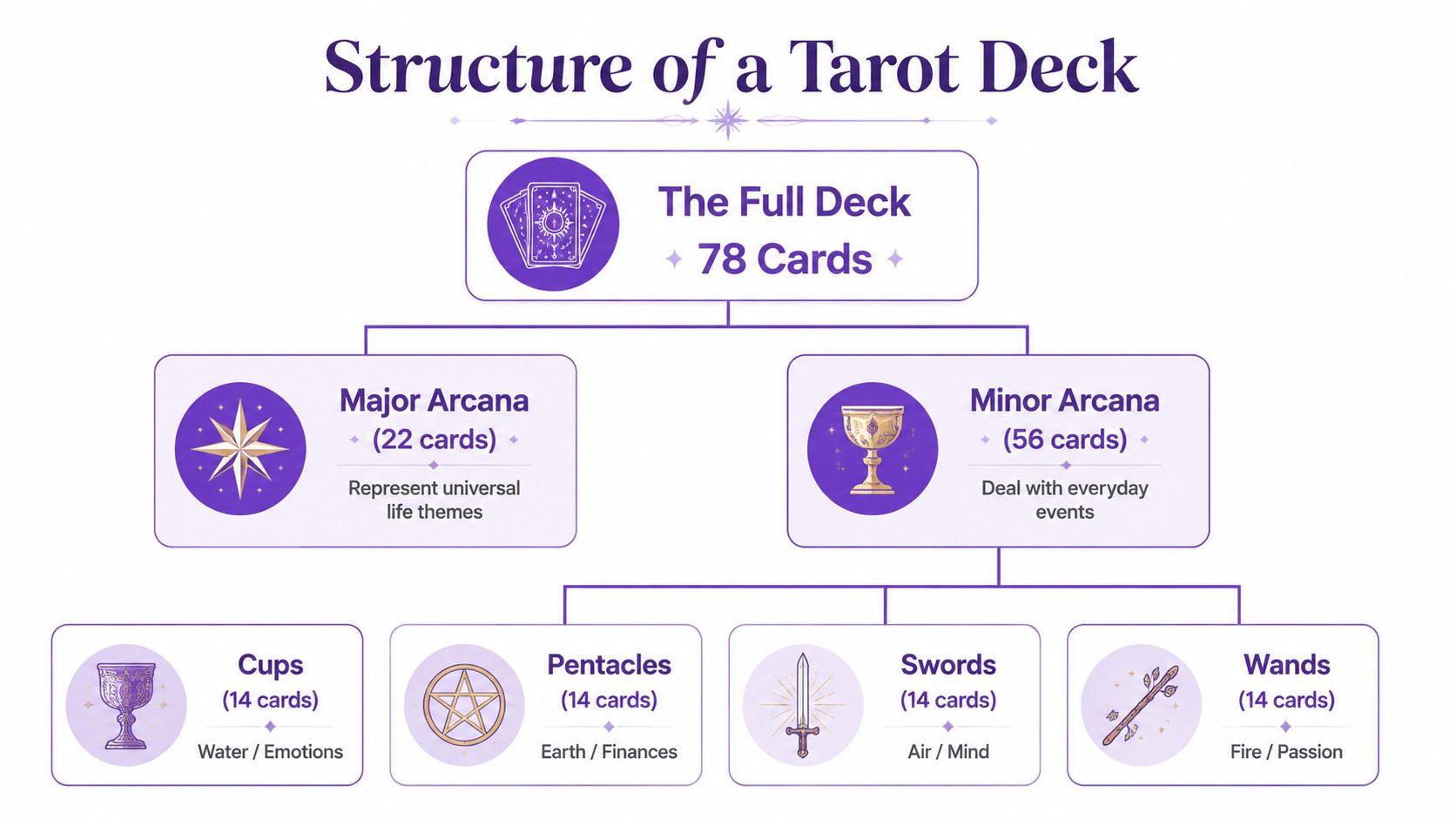
The Major Arcana, often called trumps, usually represent broad life patterns. They can point toward identity, change, conflict, learning, completion, or a significant internal shift. The Minor Arcana focuses more closely on ordinary experiences, including emotions, thoughts, relationships, work, resources, and daily choices.
The four suits create a practical map
The Minor Arcana contains four suits, each with 14 cards. Suit associations vary slightly between traditions, but this working map is useful for beginners:
- Cups: Feelings, relationships, emotional needs, and imagination.
- Pentacles: Work, money, the body, resources, and practical stability.
- Swords: Thoughts, communication, decisions, conflict, and mental pressure.
- Wands: Energy, ambition, creativity, desire, and purposeful action.
The numbered cards show stages within those areas, while the court cards often describe people, roles, attitudes, or ways of approaching a situation. You don't need to memorize every detail at once. If a spread contains several Cups, begin by asking whether the issue is primarily emotional or relational before examining the individual cards.
Tarot's structure also explains why its meanings are narrative rather than fixed. It developed from a Renaissance card system before later occult reinterpretations. French and Marseille-style traditions helped standardize the familiar deck structure, while the explicitly esoteric reputation solidified after the 1700s. A major revival as a spiritual and reflective tool occurred in the 1970s, as noted in National Geographic's history of tarot and fortune-telling.
Upright and reversed cards
An upright card appears in its normal orientation. A reversed card is upside down, but it doesn't automatically mean the opposite or something negative. It may suggest blocked energy, an internal version of the card's theme, delay, excess, or a lesson that needs attention.
For your first readings, use upright cards only. Add reversals once you can explain a card through its position and question. This keeps your early practice focused on relationship and context, rather than adding another layer before the basic method feels stable.
Reading the Major Arcana as Life Patterns
The Major Arcana becomes more manageable when you stop treating it as a vocabulary test. Instead of attaching a single keyword to each card, ask what kind of life pattern the image represents.
A card may describe a transition, a psychological state, a confrontation, a beginning, or a period of integration. The same archetype can feel supportive in one reading and demanding in another because the question changes its role.
Start with the archetype
Use this sequence when a Major Arcana card appears:
- Name the central pattern. Is the card about choice, transformation, solitude, balance, courage, or completion?
- Observe the image. Notice posture, facial expression, direction, color, objects, and movement.
- Place it in context. Ask how that pattern answers the question and fits the card's position.
- Compare neighboring cards. Supporting cards may soften the theme, while contrasting cards may reveal tension.
This is more reliable than grabbing a list of keywords and selecting whichever sounds dramatic. Expert-oriented tarot archetype guidance on decoding symbols emphasizes the combined role of archetypes, visual details, spread positions, and surrounding cards.
Consider The Hermit. In a question about learning, it might suggest focused study, privacy, or the value of an experienced guide. In a question about a strained relationship, the same card could point toward solitude, emotional distance, or a need to listen inwardly before speaking. The card hasn't changed. The question and position have narrowed its possible meanings.
Build a personal reference system
Choose one Major Arcana card and study it without immediately opening the guidebook. Write down what the figure appears to be doing, what direction the energy moves, and what question the image seems to raise. Then consult a trusted reference, compare interpretations, and keep the observations that remain useful to you.
You can use a structured tarot card meanings reference, but don't let a reference replace observation. Record your own examples over time. A card's meaning becomes easier to recall when you connect it to several real questions and positions instead of one abstract definition.
A strong beginner reading begins with the card's core pattern, then tests that pattern against the question, position, and surrounding imagery.
Repeated Major Arcana cards in a spread can draw attention to a larger transition, while repeated suits or numbers may reveal a dominant emotional, mental, practical, or energetic theme. You don't need to make that conclusion instantly. Notice the pattern, describe it plainly, and avoid turning it into an absolute forecast.
Forming a Clear Question and Choosing Your Spread
A clear question gives the reading a useful boundary. “What's going to happen to me?” leaves the situation, time frame, and personal focus undefined. Ask for perspective you can apply instead. “What should I understand about my role in this relationship right now?” creates a more workable question than “Will my relationship work?” Likewise, “How can I prepare for this interview?” keeps attention on choices and preparation rather than a fixed prediction.
For daily practice, start with a small spread. A one-card spread gives you one image to observe, while a three-card spread allows comparison without overloading you with meanings. A practical beginner tarot reading guide can help you set up a reading, and this guide to doing a tarot reading offers another structured reference.
Matching your question to the right spread
| Question Type | Recommended Spread | Why It Works |
|---|---|---|
| Daily focus | One card | It gives you one image to observe throughout the day. |
| A choice or tension | Two cards | You can compare two perspectives, options, or forces. |
| A situation unfolding over time | Three cards | Past, present, and future positions create a simple narrative. |
| A challenge requiring more detail | Five cards | Additional positions can separate the issue, obstacle, support, action, and likely direction. |
Use one card when you are studying imagery or choosing a daily focus. It cannot provide every detail of a complicated problem. Two cards work well for questions such as “What am I seeing, and what am I missing?” or “What supports this choice, and what challenges it?”
Three cards support modular learning because each position gives the card a specific role. You might use situation, challenge, and advice rather than past, present, and future. A larger layout can wait until you can explain why each position is needed and how it relates to the question.
Avoid questions that encourage dependence
Yes-or-no questions may seem efficient, but they reduce the reflection that makes tarot useful. If you use one, treat the response as a prompt for practical thought, not a guarantee about what will happen.
Write the question before shuffling. After laying out the cards, avoid repeated redraws just because you dislike the answer. The written question acts as an anchor, helping you distinguish the first interpretation from wishful revision and build a steady, honest practice.
Combining Cards Into One Coherent Reading
Pulling cards is simple. The deeper skill is turning several symbols into one clear response rather than reciting separate definitions.
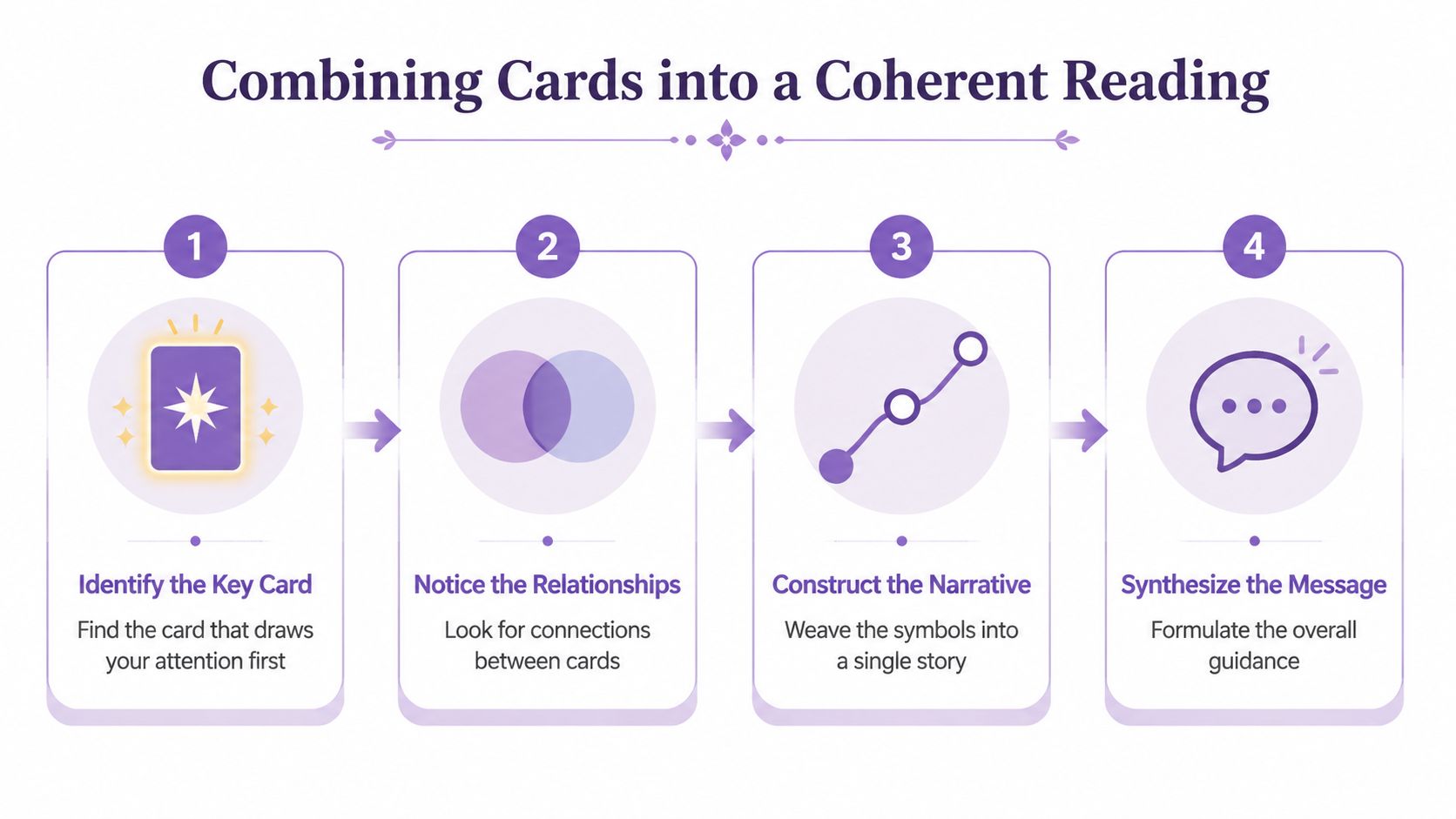
Begin by assigning each card a job. The position supplies the job, the question supplies the subject, and the image supplies the language. Then look for sequence, contrast, repetition, support, and obstruction.
A worked three-card example
Suppose your question is, “How can I approach a difficult conversation with a colleague?” You draw:
- Situation: Two of Swords
- Challenge: Five of Wands
- Advice: Queen of Cups
Read the first card as a condition, not a verdict. Two of Swords may show hesitation, guarded thinking, or a decision postponed. In the challenge position, Five of Wands can represent competing viewpoints, defensiveness, or a conversation that becomes crowded with competing agendas. Queen of Cups in the advice position shifts the response toward emotional awareness, calm listening, and measured communication.
Now connect the cards. The reader might summarize the spread this way: “You may be delaying the conversation because you're trying to avoid conflict. The discussion could become reactive if everyone argues to be heard, so approach it with emotional steadiness, listen for what sits beneath the disagreement, and speak without escalating.”
That paragraph is stronger than three disconnected lines such as “Two of Swords means indecision. Five of Wands means conflict. Queen of Cups means compassion.” The individual meanings matter, but the relationships create the reading.
Use visual composition before intuition
Ask four questions:
- Which card catches your attention first?
- Do the figures face toward or away from one another?
- Does one card intensify, soften, or contradict another?
- What changes when you read the cards from left to right?
If two cards show similar emotional or practical concerns, repetition may identify the reading's dominant pattern. If one card introduces a different suit or a Major Arcana archetype, it may function as the turning point.
Intuition can contribute, but it should be tested against structure. Look at the card, form an impression, then verify it through the question and position. This process gives your intuition boundaries and helps prevent a striking image from overwhelming the actual issue.
Synthesis test: If you can't explain the spread in one plain paragraph, return to the question and assign each card a clearer role.
End every small reading with a practical sentence. Ask, “What can I notice, discuss, prepare, or change?” That keeps the cards connected to reflection rather than spectacle.
Practicing Tarot Ethically and Avoiding Dependency
A daily tarot habit can support attention and self-reflection, but frequent pulling isn't automatically healthy practice. The warning sign is not the number of readings alone. It's the role the cards play in your decision-making.
If you keep asking the same question until you receive a comforting card, you aren't gaining clarity. You're using repetition to manage uncertainty. If you can't make a small decision without consulting the deck, the practice has moved from reflection toward dependence.
Set boundaries before you shuffle
Create rules while you feel calm, not while you're distressed. You might decide to write one reading in your journal, wait before revisiting the same question, and stop drawing when your interpretations become increasingly anxious or contradictory.
Avoid using tarot as a substitute for qualified medical, legal, financial, or mental health advice. The cards can help you name fears or clarify priorities, but trained professionals and trustworthy information should guide high-stakes decisions.
A beginner FAQ on tarot practice also highlights ethical reading and avoiding harm or dependency as concerns that deserve direct attention, not just technical instruction. That guidance appears in common tarot questions about responsible use.
Reading for yourself and others
When reading for yourself, distinguish observation from certainty. Write “I may be avoiding this conversation” rather than “This card proves the conversation will fail.”
When reading for another person, ask permission, protect their privacy, and avoid presenting interpretations as facts about someone who isn't present. Don't use the cards to make claims about another person's private thoughts or to pressure someone into a relationship, purchase, treatment, or major decision.
Put the deck away when you feel panicked, when you're seeking reassurance through repeated pulls, or when a reading encourages you to ignore direct evidence. A sustainable practice includes rest. You're still learning when you choose not to draw.
Your First Seven Days of Tarot Practice
Keep each session short enough that you can repeat it without resentment. Use the same deck, write the date and question, note the card or cards, and record your first impression before checking a guidebook.
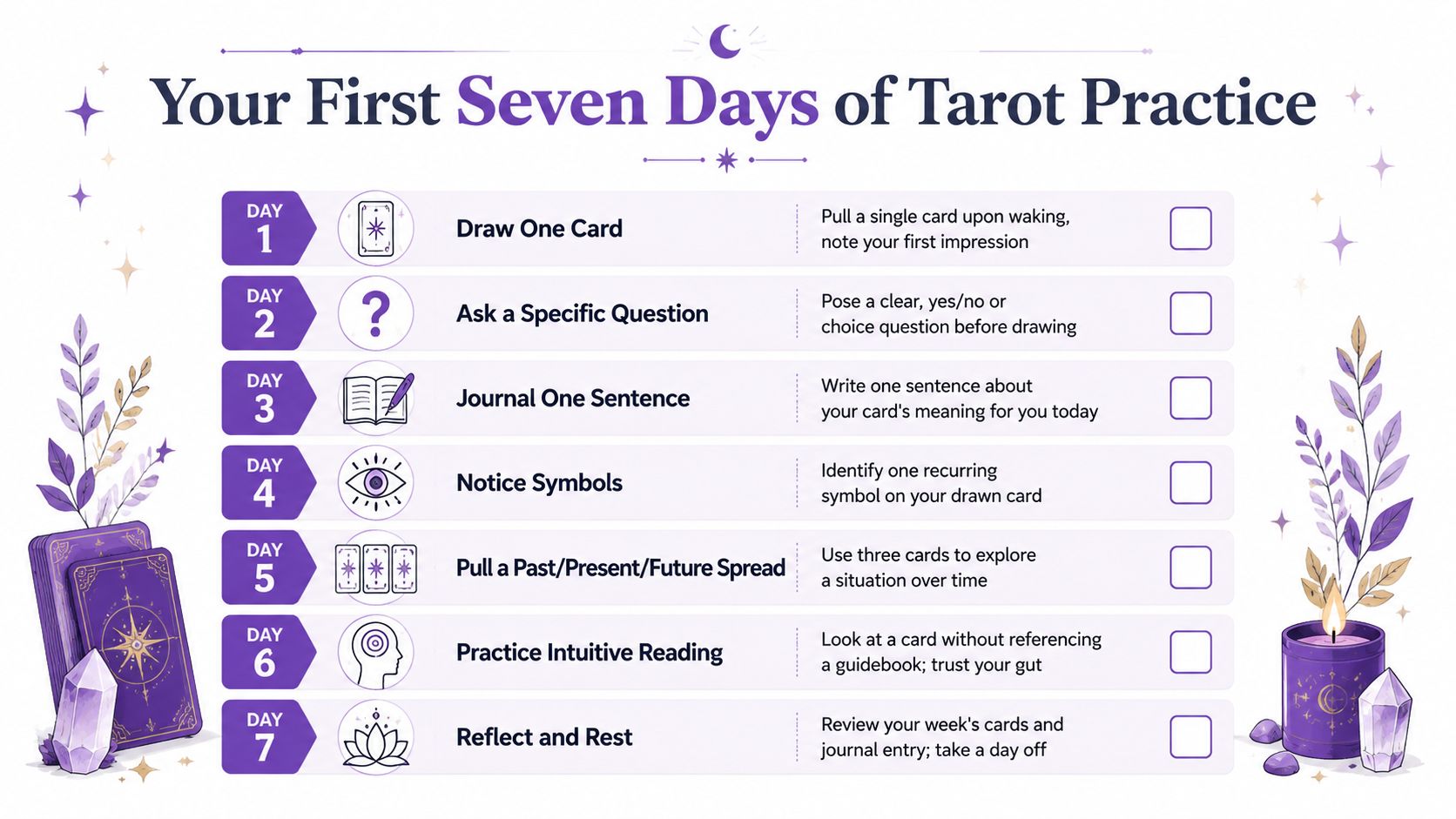
- Day 1: Draw one card and describe only what you see.
- Day 2: Ask one specific question about your day or attention.
- Day 3: Write one sentence connecting the card to your experience.
- Day 4: Study one symbol, color, posture, or direction in the image.
- Day 5: Use a three-card past, present, and future spread for one situation.
- Day 6: Read the spread without a guidebook, then compare your notes with a reference.
- Day 7: Review the week, identify recurring themes, and rest from drawing.
A reading log turns isolated impressions into a learning record. You can use a paper notebook, a notes app, or an interactive mobile tool as a practice aid, but keep your own interpretation in the record. Modular study is easier to sustain than trying to memorize the full deck in one sitting. Current beginner-oriented tarot discussions also describe interest in guidebooks, reading logs, modular archetypes, and interactive tools, with recent tarot learning trends pointing toward shorter, structured practice.
After the week, continue with one-card observation and occasional three-card readings. You're ready to expand when you can explain each card's position, connect the cards into a coherent message, and stop confidently when the reading has answered the question.
TarotElya offers free interactive readings without registration, including a daily card, three-card past-present-future reading, themed readings, card meaning pages, and guides for combinations and practice. Visit TarotElya to try a small spread, record your interpretation, and use the experience as a reflective exercise rather than a replacement for your own judgment.