
Que Significa La Estrella En El Tarot
Que significa la estrella en el tarot. Qué significa la Estrella en el tarot: upright and reversed meanings, love, work and money notes, keywords and practical
Start my free readingPublished
Updated
19 min read
You've just pulled The Star, and your first reaction may be mixed. If the spread was already heavy, with cards like The Tower, Death, or the Ten of Swords, this one can feel like a small light after a hard night. It doesn't erase what happened. It says your system is beginning to settle, and that calm is part of healing too.
That's the most useful way to approach que significa la estrella en el tarot. Not as a promise that everything instantly improves, but as a card that names the quiet period after disruption, when trust has to be rebuilt one careful step at a time. The Star is one of the Major Arcana's most optimistic symbols, and its meaning stays stable across modern tarot guides, with hope, healing, inspiration, and renewed faith after difficulty at the center of the card's message The Star in the Major Arcana.
Table of Contents
- Reading The Star After a Hard Reading
- Where The Star Sits in the Major Arcana
- Symbols on the Card and What They Mean
- Upright Meaning and Core Keywords
- The Star in Love, Work and Money
- Reversed Meaning and When It Shows Up
- Quick Reference for The Star
- Cards That Pair Well With The Star
- A Worked Three-Card Example
- Reflection Prompts to Use With The Star
- Where to Go After The Star
Reading The Star After a Hard Reading
The Star can feel almost startling when it lands after a rough spread. If you've just seen The Tower, Death, or the Ten of Swords and then The Star shows up in the outcome or advice position, the card is not pretending the damage didn't happen. It's naming the part that comes next, the exhale, the moment when your body stops bracing for impact.
What the card is really saying
A beginner often wants tarot to give a clean yes or no, but The Star works more like a recovery marker. It points to the phase where a person starts to believe again, not because everything is fixed, but because the worst pressure has passed. In that sense, the card is honest. It doesn't ask you to perform positivity, it asks you to notice that stillness after chaos is real, and useful.
Practical rule: If a hard card came before The Star, read The Star as restoration, not denial.
That calm is also why the card matters in readings about burnout, heartbreak, grief, or any period where your confidence has taken repeated hits. The image itself supports that reading, with the figure kneeling, exposed, and pouring water in two directions, one flow returning to the earth and one to the stream. The gesture looks gentle, but it's active. Healing here is not passive waiting.
So if you're reading for yourself, ask a simple question first. What part of me is finally ready to breathe? That question keeps The Star grounded in lived experience, which is where tarot is most helpful.
Where The Star Sits in the Major Arcana
The Star is card XVII, and its place in the sequence matters. In the Major Arcana, it comes after The Tower, so the card often reads as a quieter phase after disruption, when the shock has passed and orientation starts to return. The Major Arcana itself is the set of 22 trump cards, numbered from 0 to 21 Major Arcana history and structure. In that framework, XVII is linked with hope, renewal, and guidance after upheaval.
Why the sequence matters
The sequence teaches timing. The Tower breaks what cannot hold. The Star does not rush into rebuilding, it gives you a clear sky again so you can find your bearings before the next move. That is why the card feels different from images that call for action or choice. It asks for a calmer kind of attention, the kind that notices when the body is no longer on guard.
The Rider-Waite-Smith image makes that lesson easy to see. A naked figure kneels beside water, pours from two vessels, and stands beneath one large eight-pointed star with seven smaller stars around it. The scene is balanced because its symbols are balanced, sky above, earth below, water moving in two directions. You can read that as a simple lesson in recovery, keep one hand on what nourishes you, and one hand on what needs to be returned to life.
A historical image of guidance
Tarot symbols have also shifted over time. Some late 15th-century cards used a six-pointed star instead of the now-common eight-pointed version. That difference shows that the image has a history, not a single frozen form. If you want a fuller outline of how the trumps developed, the card's place in Major Arcana history and structure helps put it in context.
A useful way to hold The Star is simple. It marks the point after disruption when guidance is still available. Quiet guidance, visible guidance, steady guidance.
Symbols on the Card and What They Mean
A reading of The Star often begins with the image itself. The card speaks through small details, and each one gives a different part of the message. Hope is returning, but it returns in a way you can use.
The star, the stars, and orientation
The large eight-pointed star usually points to guidance and a renewed sense of purpose. It sits at the center of the scene like a fixed point in a dark sky. The seven smaller stars are often linked to the seven chakras, the seven classical planets, or the seven notes of the musical scale. Read together, they suggest wholeness that is starting to come back into alignment The Star symbolism and meanings.
That matters in practice. The central star gives direction, while the smaller stars suggest different parts of life beginning to work together again. You may not feel fully healed yet, but the card shows less inner pulling and more inner order.
Water, vulnerability, and the body
The two vessels carry the card's clearest action. One stream goes back into the water, the other falls onto land. That image shows nourishment moving in two directions, back into feeling and back into daily life. What was held inside is shared outward. What was dry is fed.
The nude figure is about authenticity, openness, and the choice to be seen without armor. One knee is down and one is lifted, so the body is both grounded and ready. It has the stillness of rest and the shape of a next step.
A useful reading habit helps here. If a symbol in The Star feels soft, do not mistake that softness for weakness. In tarot, gentleness often means honesty.
A bird often appears in the tree, commonly identified as an ibis, and the distant mountains widen the scene. Together they suggest that life is still present, and the road ahead is not closed. The card does not promise arrival on demand. It offers orientation, like finding a clear landmark after a long stretch of fog.
For a beginner asking qué significa la Estrella en el tarot, the answer starts with the image, not the keywords. Ask yourself: what feels restored here, what feels open, and what part of me is ready to be fed again?
Upright Meaning and Core Keywords
Upright, The Star is one of the clearest cards in the deck. Its message is not complicated, even if the feeling behind it can be delicate. Hope, healing, renewal, and quiet faith are all part of its core meaning, especially after a period of stress or disappointment.
Emotional, spiritual, and action tones
You'll read the card more accurately if you separate its tone into three layers.
Emotional tone
- Hope
- Serenity
- Vulnerability
Spiritual tone
- Faith
- Renewal
- Guidance
Action tone
- Heal
- Reorient
- Trust
These aren't random keywords. They each map back to a visual detail. The pouring water suggests healing in motion. The stars suggest direction. The kneeling figure suggests trust without performance.
How to use the keywords
A lot of beginners try to memorize every possible meaning at once, then end up overreading the card. Start simpler. Scan the words, then choose the two or three that fit the question being asked. If the question is about love, vulnerability and trust may matter more than inspiration. If the question is about work, renewal and reorient might matter more than serenity.
The upright Star is often described as a "breath of fresh air" after chaos, and that phrase works because it captures the card's tempo. It doesn't rush. It lets you recover enough clarity to act again.
If you need a single sentence to hold onto, use this one. The Star upright says healing is already underway, even if you can't measure it yet.
The Star in Love, Work and Money
The Star adapts beautifully to practical questions because its energy is steady rather than dramatic. It doesn't force a story, it softens one that's already in motion. That's why the same card can show up as emotional honesty in love, creative motivation in work, and patient recovery in money.
Love
In love, The Star points to honest affection, calm after conflict, and the slow rebuilding of trust. If you've been through a breakup, this card can describe the phase where you stop narrating the loss as if it's your identity. You start becoming open again, and that openness matters. For people already in a relationship, the card often suggests gentler communication, less defensiveness, and more room to be seen without armor.
For single readers, The Star can point toward someone gentle rather than fiery, a connection that feels safe before it feels intense. That's not a lesser kind of attraction, it's a different one. This week, have one conversation that removes a layer of pretense, even if it's only with yourself.
Work
At work, The Star usually brings renewed motivation, creative projects, or a role that matches your values more closely. It can appear when burnout has started to lift and you can feel your original interest returning. The warning is subtle, but important. Don't dull that spark by overcommitting before your energy is stable.
If a mentor, collaborator, or fresh idea enters the picture, pay attention. The Star likes guidance that restores confidence rather than pressure that drains it. This week, start the project that feels alive, not the one that only looks impressive.
Money
In money questions, The Star reads as steady recovery, small debts handled with care, and a calmer relationship with spending. It's not a flashy card, and that's useful. It rewards consistency over urgency. A budget, a payment plan, or a realistic tracking habit matters more here than any sudden win.
If money has felt tense, The Star asks you to reduce the emotional drama around it. This week, track one number, then let the number be information instead of a verdict.
Reversed Meaning and When It Shows Up
Reversed, The Star isn't the opposite of hope. It's what hope feels like when it's running low. The energy turns inward, and the card can show exhaustion, disillusionment, or a sense that healing isn't happening fast enough. The light is still there, but it doesn't feel accessible.
Common situations where it appears reversed
You'll often see this reversal when someone has been carrying prolonged burnout, repeating the same romantic pattern, losing sleep over financial anxiety, or feeling spiritually tired after intense inner work. The shared thread is depletion. The person hasn't just had a bad day, they've started to doubt whether recovery is even possible.
That's why reversed The Star asks for a gentler response than many beginners expect. It's not a dramatic warning. It's a diagnostic card. It says the inner reservoir needs attention before hope can feel believable again.
For a deeper look at how readers approach inversions, see this guide to reversed tarot cards.
What to do with the reversal
Don't force optimism. Forced optimism usually makes the reversal worse, because it adds pressure on top of depletion. Instead, treat the card as a signal to simplify. Fewer demands, more rest, less self-interrogation.
Gentle correction: Reversed The Star still asks for healing, but you have to choose it actively instead of waiting for it to arrive.
If the card shows up reversed in a spread, ask where faith has been leaking out. That question is often more useful than trying to “fix” the whole reading. Tarot works better when you let the card tell you what kind of care is needed.
Quick Reference for The Star
| Area | Upright | Reversed |
|---|---|---|
| Love | Honest affection, safe vulnerability | Fear of opening up, disillusionment |
| Work | Renewed motivation, aligned purpose | Burnout, creative dryness |
| Money | Steady recovery, calm planning | Financial worry, delayed confidence |
| Yes or no | Conditional yes | Not yet |
This quick reference works best after you've read the imagery and tone of the card. The table gives you the short version, but the surrounding cards still decide the shape of the story. If The Star appears in a love spread, for example, the upright meaning doesn't guarantee romance, it describes a situation where trust can grow.
The yes-or-no row is especially useful for beginners. Upright, The Star usually supports the question, but it does so in a calm, gradual way. Reversed, the answer is usually not yet, because the inner state behind the question needs repair first.
Read the table as a shorthand, not as a verdict. The Star is rarely a card that shouts. It tends to whisper the same message in different forms, hope is returning, or hope needs care.
Cards That Pair Well With The Star
The Star reads with more detail when another card sits beside it. On its own, it points to hope and recovery. Paired with other cards, it shows what kind of healing is happening, and what part of the story still needs care.
Strong pairings
The Tower with The Star creates a clear before-and-after sequence in the Major Arcana. The Tower shows the break, the shock, or the structure that could not hold. The Star shows the quiet that follows, the moment when breath returns and the first signs of repair appear.
The Empress or The Lovers with The Star brings the card into relationships and creative work. With The Empress, The Star can feel nurturing, as if recovery starts to grow into something fertile. With The Lovers, it often points to a bond that needs honesty and gentleness before commitment can deepen. For a closer look at how healing and balance work together, TarotElya's guide to Temperance and The Star is a useful companion read.
Three of Cups or Ace of Cups with The Star shifts the meaning toward emotional connection. The Three of Cups adds support, shared joy, and community. The Ace of Cups makes the hope feel newly open, as if feelings are ready to flow again.
Nine of Swords with The Star helps separate fear from fact. The Nine of Swords shows the mind at its most restless, while The Star brings a calmer background around that anxiety. The pair often suggests that the fear is real, but it is not the whole picture.
What dampens The Star
Cards like Five of Pentacles or Ten of Swords reversed make The Star's message more fragile. Recovery is still there, but it may need protection, patience, or practical support. The reading shifts from ease to repair.
A helpful way to study any pairing is to ask two questions in a journal: what does the second card add, and what does it block? The Star supplies the light. The partner card shows where that light reaches, or where it gets interrupted.
A Worked Three-Card Example
A three-card spread can make The Star easier to read in practice. Here the cards are The Tower in the past position, The Star in the present, and The Six of Swords in the future. The spread moves from rupture to recovery to a change of scene.
Reading the spread in order
The Tower says something gave way, or a truth arrived in a way that could not be ignored. It may point to a breakup, a job change, a hard conversation, or a self-image that stopped fitting. The point is simple. The old structure could not hold.
The Star shifts the focus to the space after impact. The card's figure pours water in two directions, and that image helps here. One stream lands on the ground, which suggests practical care, while the other returns to the pool, which suggests emotion finding its way again. In a reading, that can feel like trust returning in small pieces. You are not being asked to force confidence. You are being asked to notice that your body and mind are no longer in the same state they were in with The Tower.
The Six of Swords shows passage toward calmer water. It does not promise instant happiness. It points to a quieter crossing, where movement matters more than arrival. In this position, The Star is useful because its calm is not the finish line. It is the condition that makes the crossing possible.
For readers who want to try a spread like this, TarotElya's three-card spread page is a practical place to start.
What The Star means in context
Set between collapse and transition, The Star means more than “be hopeful.” It shows healing beginning to act like a bridge between an old life and the next one. The card becomes less general and more specific. It describes a stage of recovery where the body, feelings, and attention slowly soften.
A useful way to say this reading aloud is, “What broke was real. I am no longer inside it. I can move carefully toward something calmer.” Then write from there. Ask what still feels tender, what support you can accept, and what you do not want to carry into the next chapter.
Reflection Prompts to Use With The Star
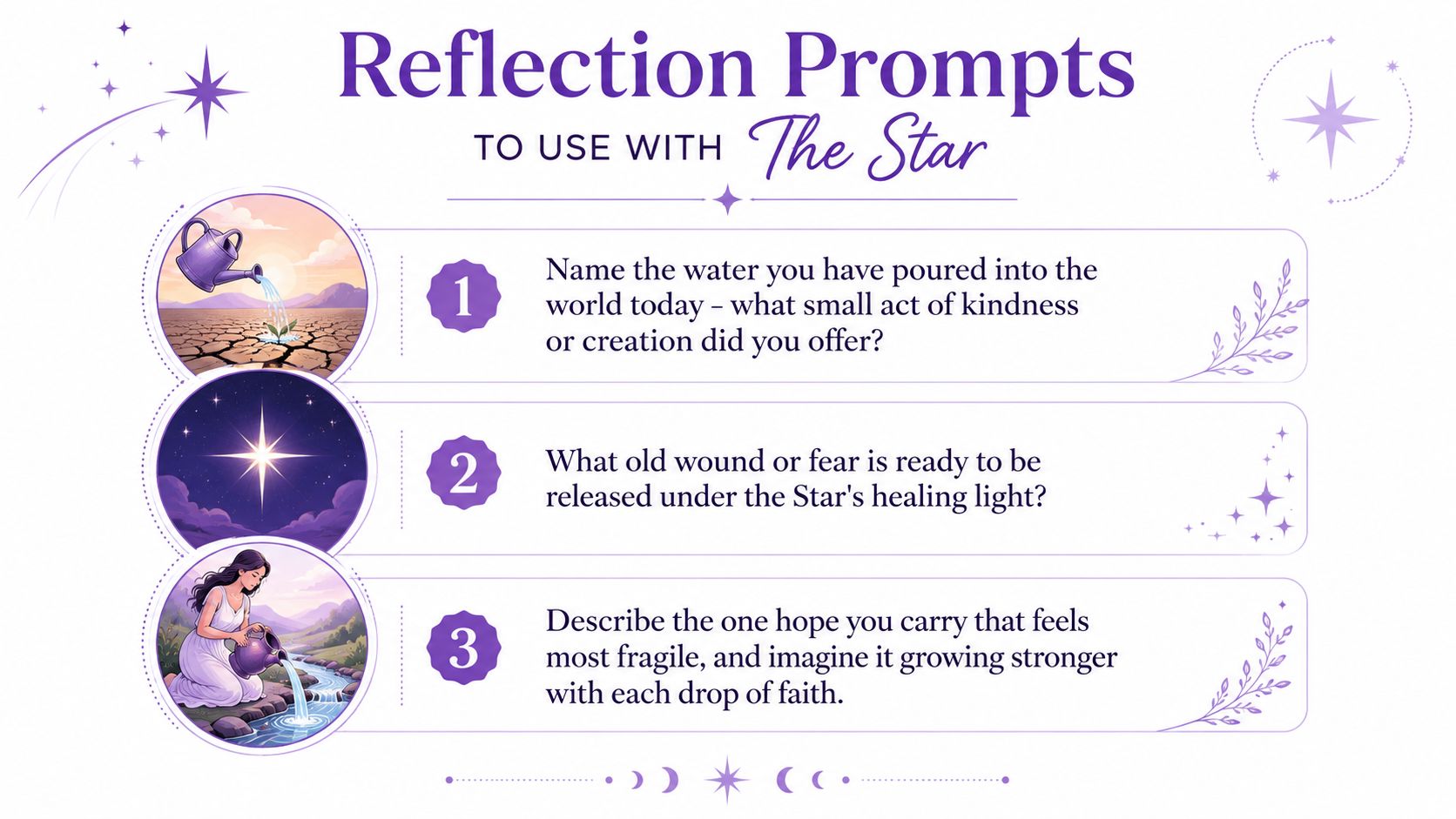
The Star becomes more useful when you tie it to something concrete on the page. Each symbol asks a different kind of question, and the prompts below follow the card's imagery instead of generic self-help language.
Write with the water on land
The water poured onto land suggests practical replenishment. That can be a small act of care, a repair you made, or a commitment you honored even while tired. Write about the water you have poured into the world recently, meaning the concrete thing you did that helped restore something real.
Write with the water in the stream
The stream side of the card is about letting emotion keep moving. If you've held too much in, this symbol asks where release already happened, or where it needs to happen now. Write about what you've let flow out instead of bottling up, whether that's grief, relief, anger, or truth.
Write with the stars above
The star cluster reminds you that guidance can be fragmented and still be real. You don't need a full map to notice direction. Write about which hopes still feel visible, even after a hard season, and which principle, value, or small belief is still guiding you.
Write slowly. One symbol, one page, one honest answer is enough.
Where to Go After The Star
Upright, The Star says hope has returned after The Tower. Reversed, it says hope has grown faint and needs care before it can do useful work again. That makes the next card, The Moon, a valuable study partner because its mood is different, less clear, more uncertain, and more concerned with what's hidden than what's healed.
If you want to keep practicing, try a simple past-present-future spread and let The Star sit in the present position. That placement is especially good for learning how a card changes when it describes an active phase instead of a final answer. After that, go back to your journal entries from the prompts above and see which symbol felt easiest to answer.
The Star asks you to trust what's returning, and to keep your attention on that returning.
TarotElya offers free, interactive tarot readings and card meanings you can use for reflection, including spreads, reversals, and themed guides for love, work, and money. If you want to keep studying The Star in a practical way, visit TarotElya and try a reading with the same card you've just learned to recognize more clearly.