
How to Read Tarot Cards: A Practical Beginner's Guide
Learn how to read tarot cards with a clear, step-by-step method. Choose a deck, master basic spreads, interpret combinations, and build a daily practice.
Start my free readingPublished
Updated
13 min read
You've got a new deck on the table, a question in mind, and too many card meanings bouncing around in your head. That first shuffle can feel weirdly heavy, especially when you want a clear answer and the cards seem to speak in symbols instead of plain English. The good news is that how to read tarot cards is a skill, not a personality trait, and beginners usually need a method more than they need more keywords.
Tarot has a long history as a structured interpretive practice. The late-18th-century rules that shaped modern reading, plus the Rider-Waite deck's visual system from 1909, still influence the way most beginners learn today, which is why a clear workflow matters so much [V&A tarot history overview]. If you approach the cards as a language of patterns, position, and narrative, the whole process gets less vague and a lot more usable.
Table of Contents
- What Reading Tarot Actually Means
- Choosing Your First Tarot Deck
- Preparing for a Reading
- Three Essential Spreads for Beginners
- Interpreting Cards as a Connected Story
- Common Mistakes That Block Progress
- Building a Sustainable Practice Routine
What Reading Tarot Actually Means
A tarot reading works best when you treat it as a structured way to think, not a test of psychic talent. The cards help you notice patterns, surface tension, and look at choices more clearly. Academic discussion of tarot's usefulness points more toward self-awareness, decision-making, and reduced anxiety or stress than toward reliable forecasting, which is why a useful reading usually asks, “What does this spread help me understand?” rather than “What will happen?” [academic review on tarot and psychological utility].
A vague question usually produces a vague reading. A concrete question gives the cards something to work with, such as what is driving a situation, what you may be overlooking, and what response fits next. For more background on the practice itself, What Is Tarot Card Reading offers a plain-language overview.
Practical rule: Use tarot to clarify a situation, not to hand over your judgment.
That does not make the practice less real. It changes what counts as success. A strong reading does not need to spell out every detail of the future, it needs to produce a coherent, usable interpretation you can work with.
The method also fits tarot's history. Modern reading still reflects the late-18th-century ideas of fixed meanings, spreads, and reversed cards, and the Rider-Waite visual system made symbolic reading easier for beginners [V&A tarot history overview]. Once you see tarot as a language with grammar, not just a list of keywords, the task becomes simpler. You read the card first, then the position, then the way the cards answer each other. That order keeps intuition grounded instead of scattered.
Choosing Your First Tarot Deck
A beginner-friendly deck gives you images that are easy to read. Beautiful artwork helps, but clarity matters more than style. The cards should show a recognizable scene, keep the suit structure intact, and use symbols you can compare with other readers' notes.
The Rider-Waite-Smith system is still the clearest starting point because it gives beginners a shared visual language. The minor arcana is fully illustrated, so you can read many cards from image, number, and suit together instead of relying on memory alone. That matters when you are still learning how the parts of a card work as one message.
Major tarot deck traditions compared
| Deck System | Beginner Friendliness | Imagery Style | Learning Resources |
|---|---|---|---|
| Rider-Waite-Smith | High | Fully illustrated minors, symbolic and direct | Very abundant |
| Marseille | Medium | More abstract pip cards, less pictorial guidance | Moderate |
| Thoth | Medium to low | Dense symbolic system, more specialized language | Strong, but less beginner-focused |
The Marseille system can suit readers who enjoy number patterns and traditional structure, but the imagery gives less immediate guidance. The Thoth system is rich and intellectually interesting, yet it usually asks for more background study than a first deck should require. If your goal is to learn without feeling buried, Rider-Waite-Smith remains the clearest on-ramp.
Physical feel matters too. Card size should fit your hands. Card stock should shuffle without sticking. The guidebook should explain the deck's symbols instead of assuming you already know them. A deck may look beautiful online and still feel hard to study if the images are too abstract to read consistently.
Use a simple test. If you can glance at a card and notice the scene, the direction of the figures, and the mood right away, the deck is probably workable for study. If you need the booklet for every card, set it aside for later. Beginners usually learn faster when the deck itself does part of the teaching.
Preparing for a Reading
Before you pull anything, slow the process down just enough to define what you're asking. A reading becomes easier when you write the question in one sentence, decide what kind of answer would help, and clear your head for a moment before shuffling. This takes less than two minutes, and it removes a surprising amount of noise.

A simple pre-reading ritual
Start with one breath and one sentence. Then write your question. If the question sounds fuzzy, tighten it until it points to a real decision or emotional issue.
- Name the topic clearly: “My job search,” “this relationship,” or “my next step with money” is much easier to read than “my life.”
- Ask for guidance, context, or likely direction: These frames work better than trying to force tarot into a yes-or-no box.
- Decide whether reversals are in play: If you use reversed cards, keep that rule consistent for the whole session.
Vague questions often create vague spreads because the cards have nothing precise to respond to. “What do I need to know about my relationship?” is usually more workable than “Will this work out?” The first question opens space for context. The second asks the cards to replace your judgment with a binary outcome.
If you're not sure what to ask, begin with the friction point. What feels unclear, tense, or unfinished right now? That's usually where the reading has the most value. The cards don't need a perfect question. They need a specific enough one that your mind can recognize the answer when it appears.
A consistent setup also helps. Sit in the same place when you can. Shuffle in the same way. Use the same notebook. Routine reduces performance anxiety and makes it easier to notice how your readings change over time.
Three Essential Spreads for Beginners
You don't need a dramatic layout to get a useful reading. In fact, complex spreads can hide the basic logic you're trying to learn. Start with small structures that let you see how position changes meaning, then add complexity only when the simpler formats feel natural.
The three-card tarot reading guide is a good example of why simple spreads work so well. With only a few positions, you can focus on how the cards relate instead of getting lost in the mechanics.
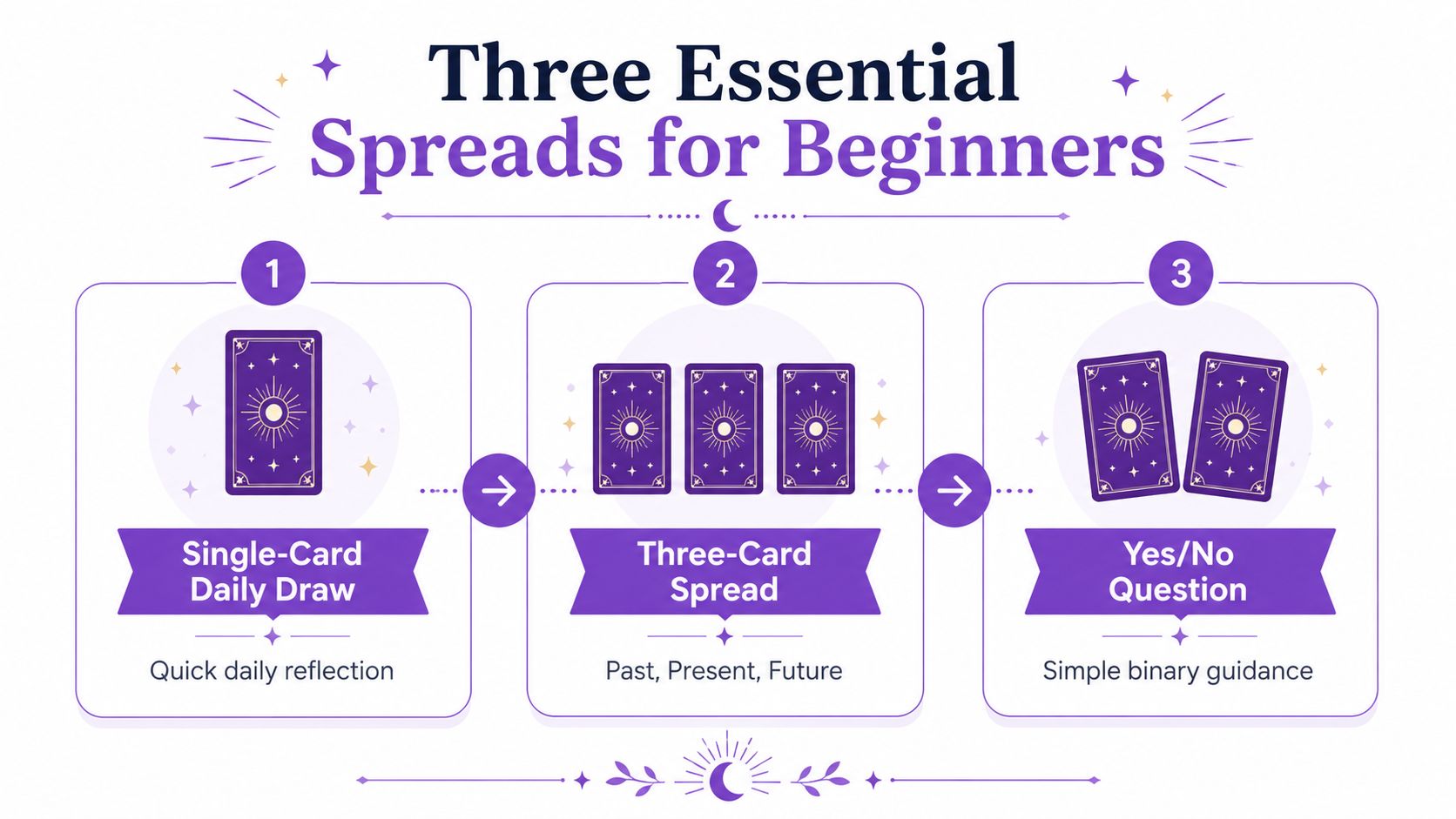
Single card daily draw
Use this for a quick check-in, not for life-changing decisions. Ask, “What energy should I notice today?” or “What mindset will help me most right now?” Pull one card, write your first reaction, and leave it there.
A single card is useful because it forces focus. It's also limited, which is why it works best as a short reflection practice rather than a full analysis. If the card feels unclear, describe the image before you reach for the meaning.
Three card spread
This is the best beginner workhorse. A common version uses past, present, future, but you can also use situation, challenge, advice if that fits your question better. Define the position meanings before you shuffle, so you're not inventing the rules after the cards appear.
Five card spread
Use five cards when a question has layers and you need more context. A simple layout might be current situation, obstacle, what supports you, likely trend, advice. It's still manageable, but it gives enough room for connections to emerge.
Strong default: Start with one card or three cards. Add more only when the question genuinely needs more depth.
For a quick visual walkthrough, the short embedded lesson below is helpful.
When choosing between spreads, let the question decide. If you want a daily mindset check, one card is enough. If you want context around a decision, three cards usually do the job. If you want to explore a specific problem without drowning in detail, five cards gives you room to think.
Interpreting Cards as a Connected Story
The hardest part for most beginners is not drawing cards. It's turning separate cards into one meaningful answer. If you only memorize keywords, the reading stays flat. The fix is to treat each spread as a conversation, where each card affects the others and the position changes the tone.
You can also use card combinations as a study tool once you're ready to see how adjacent cards reshape each other.
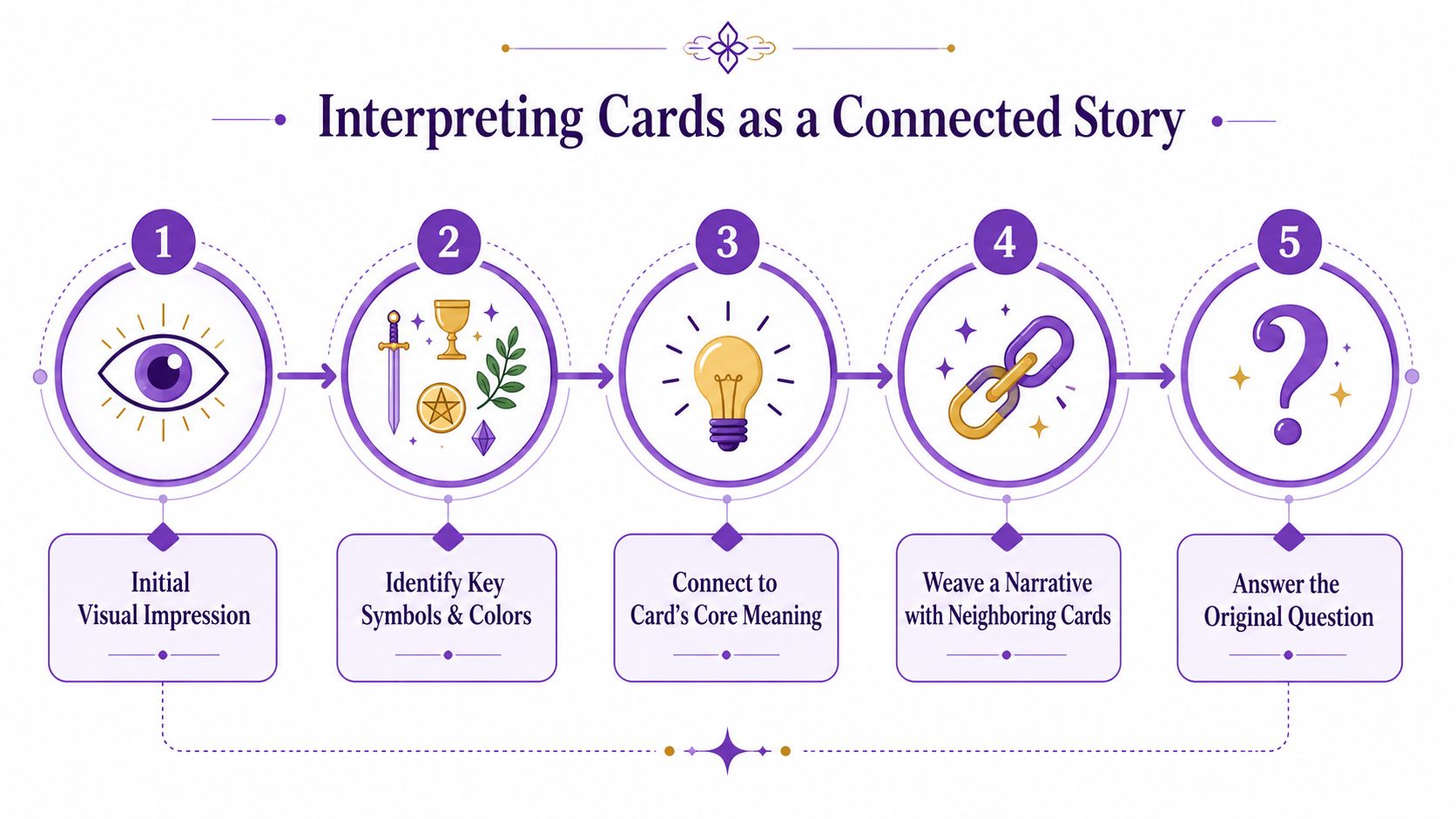
Read the spread in order
Start with your first visual impression. Notice the colors, figures, movement, and whether the scene feels open or blocked. Then identify suit patterns and number patterns across the spread. Repeated suits often point to the same area of life, while repeated numbers can suggest a shared rhythm or stage.
Let position do its job
A card in the “challenge” position does not mean the same thing as that same card in the “advice” position. The card's basic meaning stays recognizable, but the role it plays in the reading shifts. A difficult card can become useful when it shows a warning, and a positive card can become frustrating when it lands in a blocked position.
Useful habit: Read each card once by itself, then again in relation to the cards beside it.
A good reading often emerges when two cards answer each other. One card may describe a feeling, while the next shows the cause. One may point to action, while the other shows resistance. That's why overloading every card with every possible meaning usually makes the spread worse. Pick the strongest connection and build from there.
Here's a simple example. Suppose the same card appears in a “future” position and in a “support” position in a different spread. The card doesn't become a different card. Its function changes because the question changed. That shift is the heart of interpretation.
If you get stuck, tell the story in plain language. “This looks like hesitation in the middle of a bigger change” is often better than trying to name ten separate symbols. Tarot rewards clarity. You don't need a perfect theory, you need a sentence that makes sense.
Common Mistakes That Block Progress
Most beginner problems come from process, not intuition. People usually think they need more talent, when they need fewer moving parts. The fastest way to improve is to identify the habits that make a reading foggy and remove them one by one.
One of the biggest mistakes is pulling too many cards too soon. A spread can turn muddy when every position gets three clarifying cards and each clarifier creates another question. If the reading starts to sprawl, stop and restate the original question in one sentence.
Another common error is treating tarot like a literal forecasting machine. That mindset pushes people to ask the wrong questions and then feel disappointed when the spread doesn't behave like a calendar. Tarot works better as a reflective prompt, which means you're looking for the shape of a situation, not a guaranteed event.
Beginners also over-research meanings. They read so many interpretations that their own reaction gets buried. If that happens, return to the card image, the position, and the strongest word that comes to mind first. You can always study more later. You can't recover a reading once you've drowned it in too many borrowed meanings.
The yes-or-no question creates its own trap. Upright equals yes and reversed equals no sounds neat, but it strips away nuance and often produces false confidence. A better approach is to ask what supports the outcome, what blocks it, and what action changes the direction. That keeps tarot in the realm of guidance instead of coin-flip certainty.
A final mistake is quitting because the first readings feel clumsy. That's normal. Early readings are often awkward because you're learning the deck's visual language and your own interpretive style at the same time. Keep the deck, simplify the spread, and let the patterns become familiar before you judge your ability.
Building a Sustainable Practice Routine
Skill grows through repetition, not marathon study days. A practical routine gives you enough structure to improve without turning tarot into homework. Keep it simple, keep it repeatable, and keep the notes short enough that you'll maintain them.
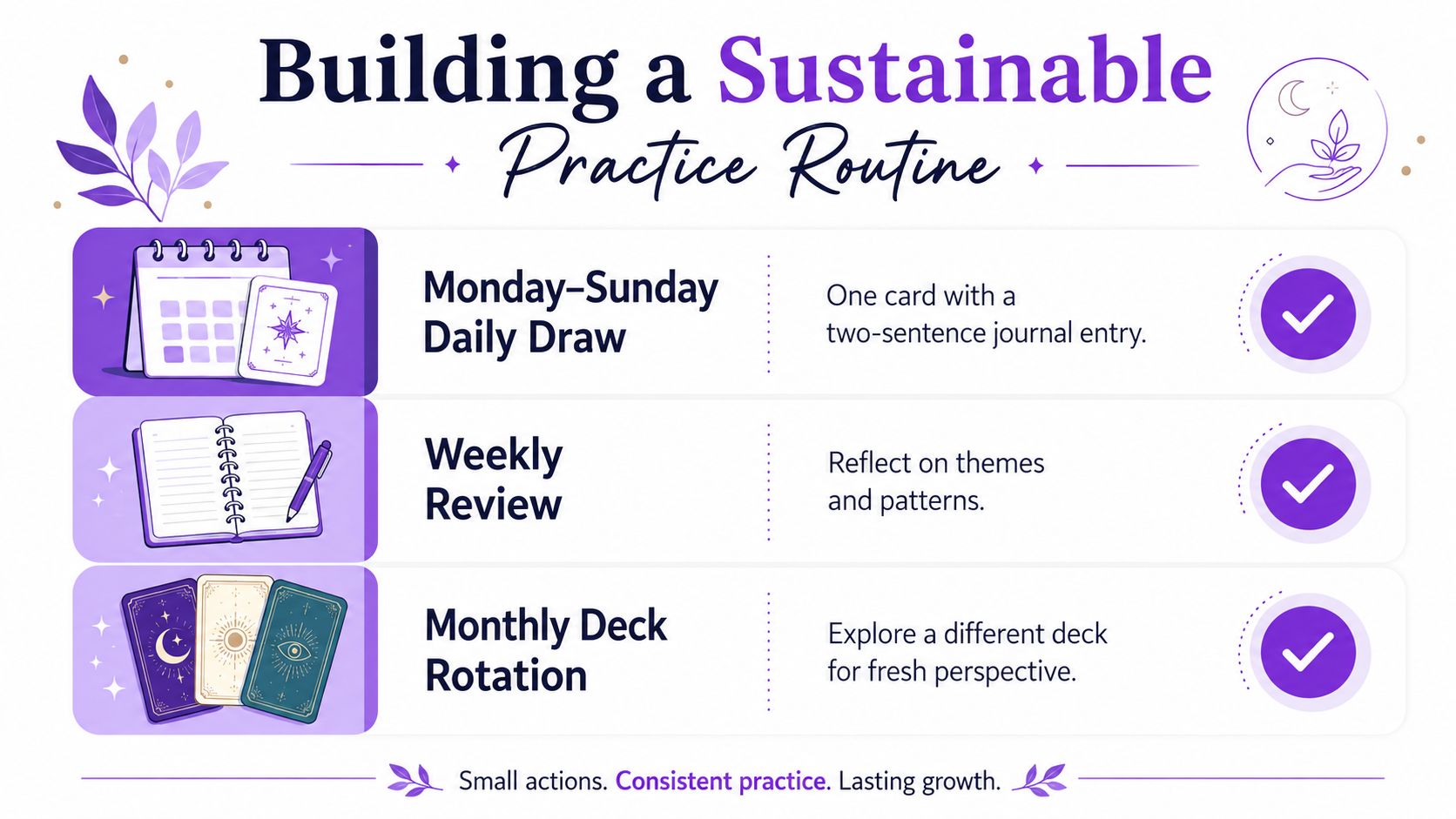
A routine that fits a busy week
- Monday through Sunday daily draw: Pull one card and write two sentences, one for your first impression and one for how it relates to your day.
- Weekly review: Read back through the week's notes and look for repeated themes, repeated suits, or repeated emotional tones.
- Monthly deck rotation: If you have another deck, use it for a few readings so you can see whether your interpretation changes with different imagery.
A daily draw trains recognition. A weekly reading trains synthesis. A monthly review trains memory, which is where you start to see your own patterns as a reader. You'll notice which symbols you overvalue, which positions you often misread, and which cards you keep simplifying too much.
Once you can read the minors without constant reference, spend more time with the Major Arcana and court cards. Those cards often carry broader narrative weight, so they're worth extra attention when your basics feel steadier. If you use a mobile app or an online deck while traveling, that still counts as practice. Consistency matters more than format.
A sustainable tarot habit should feel like a conversation, not a performance review. When you keep the practice small, the cards start to feel familiar faster, and your interpretations become cleaner because you're not forcing them.
If you want a place to practice that keeps the process simple, TarotElya offers free interactive tarot draws, beginner-friendly guides, and reading formats like three-card, daily card, and yes-or-no layouts. Visit TarotElya to try a reading, compare spreads, and build your own steady practice without extra friction.