
El Oraculo Tarot
El oraculo tarot. Discover what El Oráculo Tarot means, how oracle-style readings differ from traditional tarot, and how to use them
Start my free readingPublished
Updated
13 min read
Can a card tell you what will happen, or does it help you notice what you already know but haven't yet put into words? That question sits at the heart of el Oráculo Tarot, a phrase many readers use when looking for quick, intuitive guidance about love, work, personal choices, or the future.
A grounded approach treats the reading as a structured conversation with your own attention. The cards offer symbols, patterns, and prompts. You bring the context, judgment, and responsibility for what happens next. Tarot's long history supports that reflective role: the earliest references date to the 1440s and 1450s in Italian cities, where tarot first appeared as a recreational courtly card game before later being reinterpreted for divination, as described in the historical overview of tarot's origins.
Table of Contents
- What El Oráculo Tarot Actually Means
- Oracle Cards Vs Traditional Tarot Decks
- Why Oracle-Style Readings Feel Meaningful
- How to Conduct an Oracle-Style Tarot Reading
- Common Misconceptions About Oracle Readings
- Integrating Oracle Readings into Daily Reflection
- Next Steps and Resources for Deeper Learning
What El Oráculo Tarot Actually Means
El Oráculo Tarot combines two related ideas. Oráculo means “oracle” in Spanish, while tarot refers to a card system with established symbols, suits, and archetypal images. In everyday use, the phrase often describes a tarot reading approached in an oracle-like way, with a direct question, an intuitive interpretation, and practical guidance.
That doesn't necessarily mean the reader is using a separate oracle deck. Oracle cards can follow any structure a deck creator chooses, while traditional tarot has a recognizable system. An oracle-style tarot reading borrows the openness of oracle cards and applies it to tarot's symbolic framework.
The distinction matters because it shapes your expectations. A card isn't a guaranteed report about an unchangeable future. It's more useful as a prompt that helps you examine your feelings, assumptions, options, and next steps. A reading can highlight a tension you've been avoiding or suggest a question you hadn't considered, but it can't replace evidence, communication, professional advice, or your own decision-making.
A useful starting point: Ask the cards for perspective, not permission to stop thinking.
A first reading works best when you define the question before drawing. “Will everything work out?” gives you little to act on. “What should I understand about my hesitation before accepting this opportunity?” creates room for a meaningful response.
For a clear introduction to the practice, explore this guide to what a tarot card reading is. It helps separate the ritual of drawing cards from the stronger claim that cards can prove what will happen.
Oracle Cards Vs Traditional Tarot Decks
The main difference is structure. Traditional tarot uses a 78-card system divided into the Major Arcana and Minor Arcana. The Major Arcana focuses on broad archetypal themes and turning points, while the Minor Arcana works through everyday experiences using suits, numbered cards, and court cards.
Oracle decks don't share one universal format. A deck might focus on animals, affirmations, mythology, relationships, seasons, or personal growth. Its number of cards, keywords, imagery, and reading instructions depend on the creator. That flexibility can make oracle cards approachable, while tarot's consistent structure gives readers a deeper symbolic language to study.
| Feature | Traditional Tarot | Oracle Cards |
|---|---|---|
| Structure | Fixed system with Major and Minor Arcana | No required structure |
| Number of cards | Commonly uses a 78-card deck | Varies by deck |
| Learning style | Builds through shared symbols, suits, and card relationships | Depends on the deck's theme and guidebook |
| Reading style | Often uses spreads with defined positions | Can be freeform, keyword-based, or spread-based |
| Best suited to | Detailed questions and layered situations | Flexible prompts and intuitive exploration |
| Reversals | Many readers interpret upside-down cards | Optional and deck-dependent |
| Consistency across decks | Core meanings remain broadly recognizable | Meanings can change substantially between decks |
Choose traditional tarot when you want to examine a situation from several angles. A three-card spread can separate past influences, the present dynamic, and a possible direction. A larger spread can help you explore obstacles, resources, outside influences, and a practical response.
Choose oracle cards when you want a concise prompt or when a theme-specific deck speaks more directly to your question. You can also combine both. For example, a tarot card can provide the situation's structure, while an oracle card adds a plain-language reflection prompt.
The choice isn't about which deck has more authority. It's about which format helps you ask a better question and stay engaged with your own interpretation.
Why Oracle-Style Readings Feel Meaningful
An oracle-style reading can feel remarkably personal even when the card's message is broad. Psychology offers several reasons for that experience without requiring a claim that the cards predict events.
One is the Barnum effect, the tendency to recognize general or ambiguous statements as highly specific descriptions of ourselves. A message about wanting independence while also seeking reassurance may apply to many people, but your current circumstances determine which part feels most relevant.
Another mechanism is confirmation bias. After drawing a card, you may naturally focus on details that match your concerns and overlook details that don't. That doesn't make the reading useless. It means you should treat your first reaction as material for examination rather than proof.
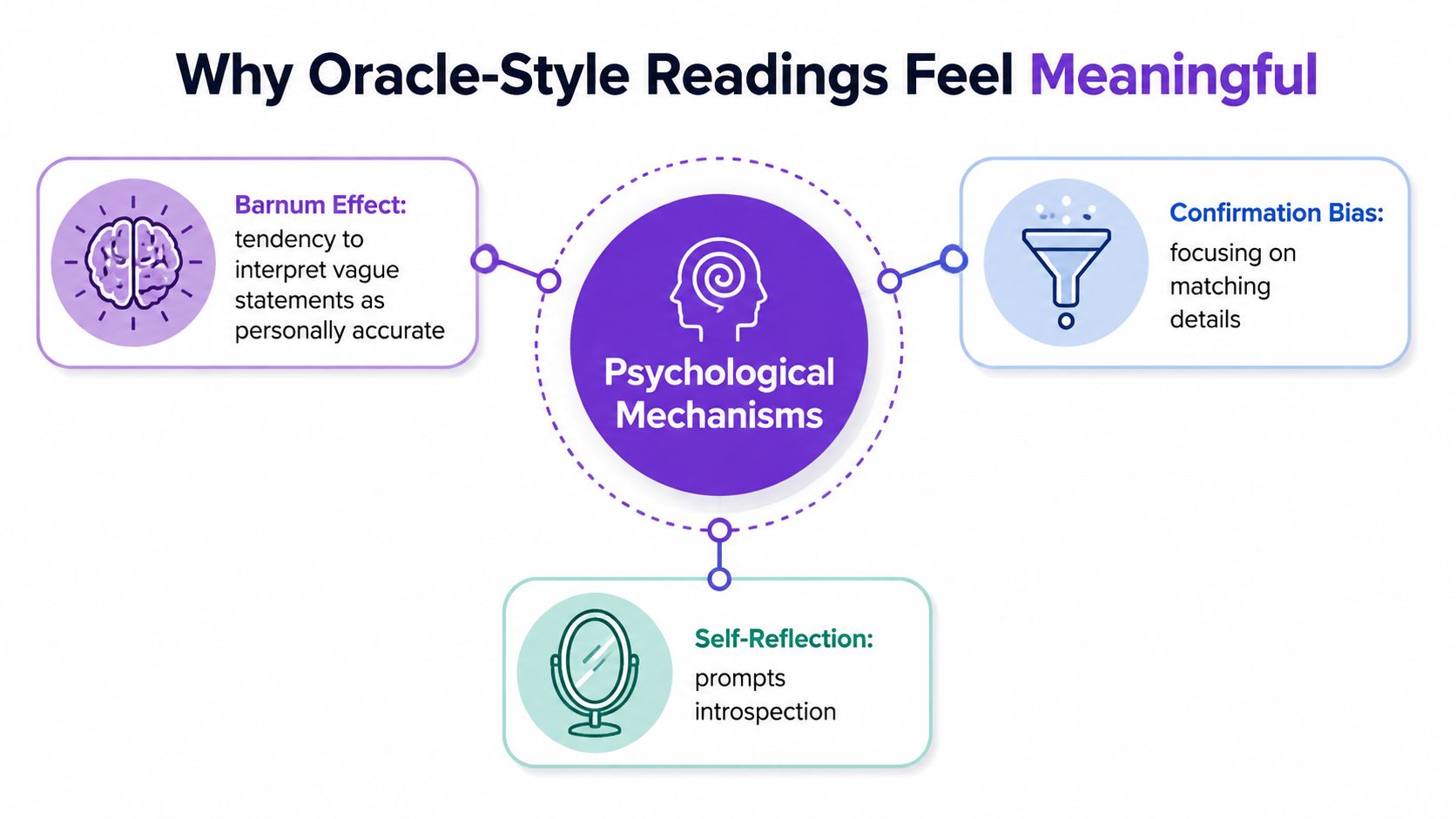
The card as a reflective mirror
Tarot can give an abstract concern a visible form. If you're uncertain about a job, the image of a guarded figure might prompt you to ask whether you're protecting yourself from a real risk or from discomfort caused by change. The card hasn't established the answer. It has made the question easier to see.
Research on tarot use identifies the Barnum effect and cold reading as nonparanormal explanations for why interpretations can seem persuasive. Related academic discussion presents tarot as a framework for meaning-making, projection, self-reflection, and narrative work, as described in this research discussion of tarot and reflective interpretation.
How to keep the insight honest
Write down your interpretation before reading a longer guidebook explanation. Note the image that caught your attention, the emotion it triggered, and the real-world situation it resembles. Then ask:
- What fits: Which part connects directly to something happening now?
- What doesn't fit: Which details are you stretching to make relevant?
- What changes: What small action would test the interpretation?
- What evidence matters: What information exists outside the reading?
This process protects the useful part of symbolism while reducing passive acceptance. The card becomes a prompt for better thinking, not an external authority that makes the decision for you.
How to Conduct an Oracle-Style Tarot Reading
A practical reading doesn't need a complicated spread. Begin with a question that names the situation and asks for insight you can use.
“Should I leave my job?” is emotionally direct but too broad for a single card. “What should I consider before deciding whether to leave my job?” is more workable because it invites analysis rather than a command.
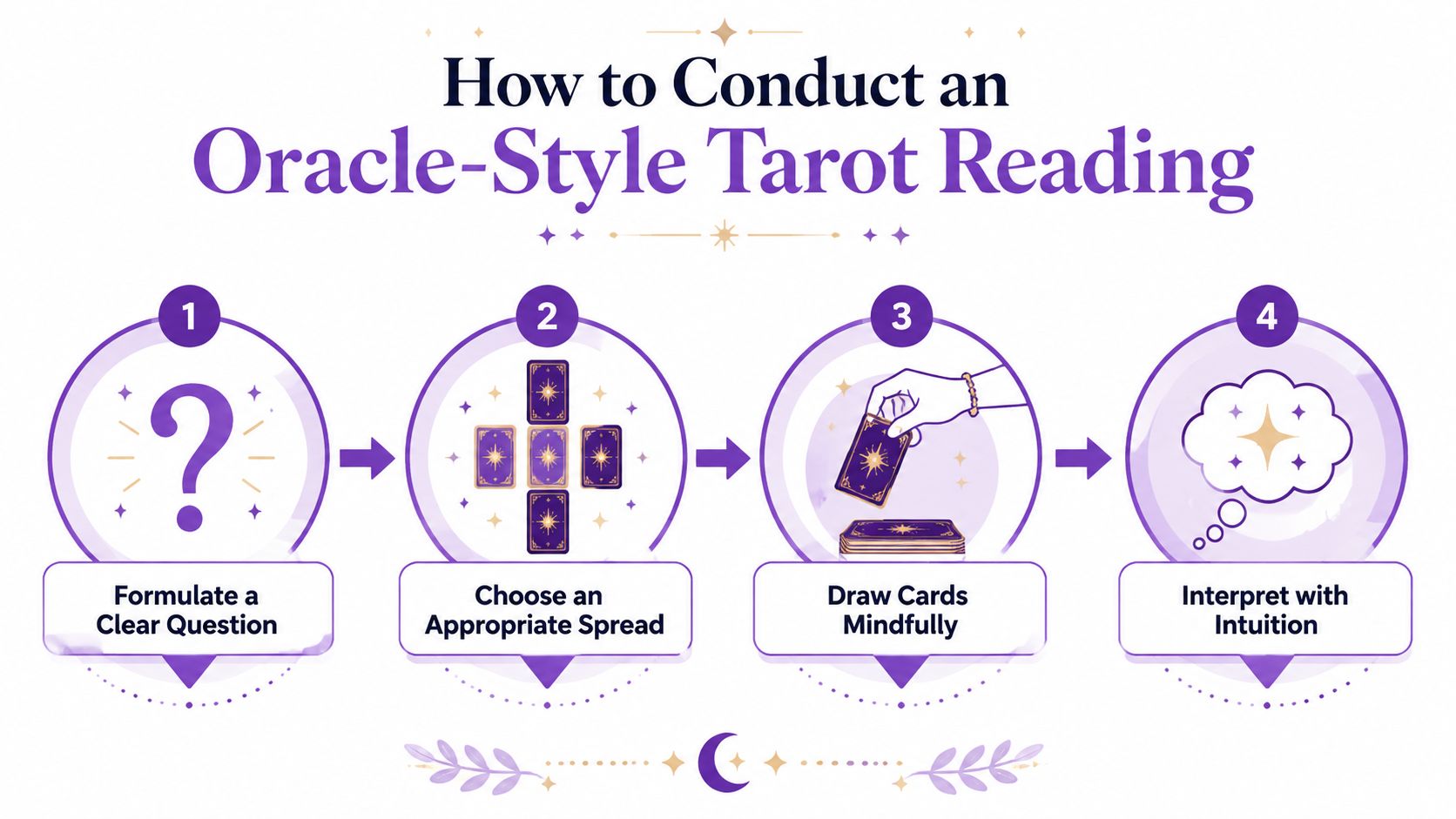
Use a small spread first
Start with one to three cards. Give every position a job before you draw.
- One card, the focus: What deserves my attention today?
- Two cards, tension and response: What is challenging me, and how can I respond?
- Three cards, context and action: What shaped this situation, what is active now, and what practical step is available?
Shuffle in a way that feels deliberate. With a physical deck, you might cut the cards or draw from the top. On a digital platform, clicking or touching to choose and reveal a card can preserve the ritual of participation rather than presenting a result without interaction.
Digital divination is still a computerized card-drawing ritual. Scholarship describes the shift from physical randomness to mediated interaction through mouse clicks or touch gestures, while the ritual structure remains. A 2025 experiment also found that interaction modality affects perceived sacredness, with oral conversation producing higher perceived sacredness than touchscreen interaction. The same study found that explicit AI involvement reduced trust and perceived service quality among spiritual believers, though not among nonbelievers, as detailed in this study of AI-assisted tarot interaction.
Interpret position before prediction
Suppose you draw a card associated with withdrawal in the “current situation” position. Don't immediately translate it into “the relationship will end.” Read it through the position: perhaps you need space, a private conversation, or time to distinguish exhaustion from loss of interest.
If you use reversed cards, decide what they mean before the reading. A reversal might suggest blocked energy, an internal version of the card's theme, excess, delay, or a need to reconsider the upright meaning. It doesn't automatically mean the opposite.
For a practical walkthrough in Spanish, see this guide on how to do a tarot spread. After the reading, write one interpretation and one action. Don't draw additional cards just because the first answer feels uncomfortable.
Common Misconceptions About Oracle Readings
The most damaging misconception is that an oracle reading guarantees a specific outcome. It doesn't. A card may help you describe a pattern, but future events depend on changing circumstances, other people's choices, and actions you haven't taken yet.
Exact timing is another common trap. A symbolic image can suggest urgency, patience, repetition, or transition, but it can't reliably establish a calendar date. Treat timing language as a prompt to examine readiness and conditions, not as a promise.
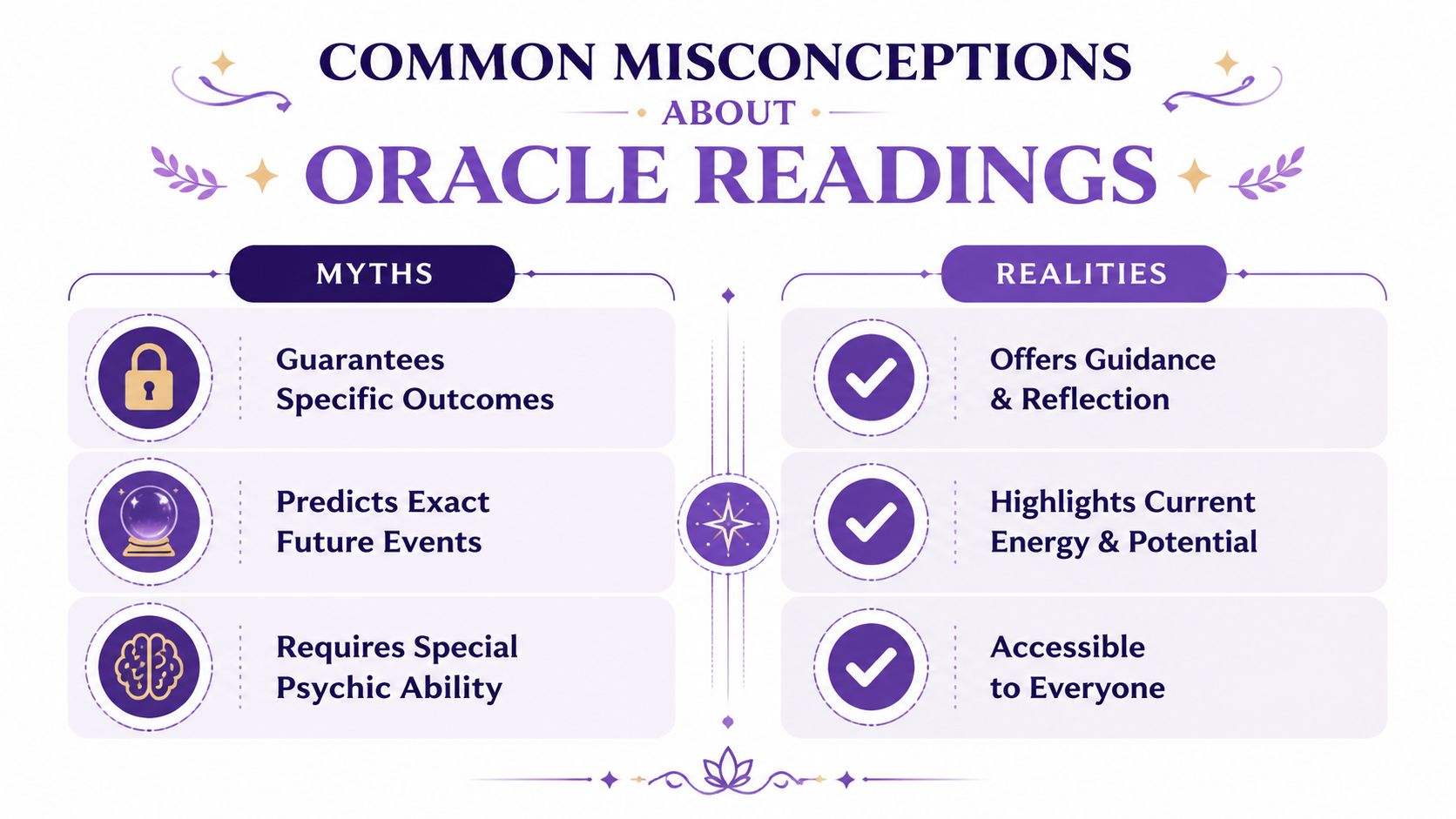
What the cards can't establish
A reading can't verify another person's private thoughts. If you ask, “Does my former partner secretly want to return?” the card reflects your question and your interpretive frame. It can't provide consent, direct communication, or reliable access to someone else's mind.
Yes/no readings have a similar limitation. A “yes,” “no,” or “maybe” can simplify a complicated choice, but the advice attached to it may be more useful than the label. “Maybe” might indicate missing information, conflicting priorities, or a decision that depends on an action you control.
A simple bias check
Before accepting an interpretation, ask whether you'd describe the same card differently if you wanted the opposite answer. If the answer is yes, pause and write down the evidence for both possibilities.
A reading is too vague to use when it gives you no identifiable situation, no question to investigate, and no action to test. It's also a warning sign when you keep drawing cards until one agrees with what you already want.
Decision boundary: Never use a card to override safety information, legal guidance, medical advice, financial analysis, or direct communication.
You don't need special psychic ability to reflect with cards. You need a clear question, enough patience to consider uncomfortable interpretations, and the discipline to separate symbolic insight from factual certainty.
Integrating Oracle Readings into Daily Reflection
A daily card works best as a short journaling prompt, not as a forecast that controls your schedule. Draw a card, record your first response, and connect it to one concrete situation. As the day unfolds, review what you noticed without forcing events to match the card.
A simple entry can include:
- The prompt: What quality should I bring to today?
- The reaction: What did the image make me feel?
- The application: Where could that quality help?
- The check: What happened that related, and what didn't?
For relationships, use the card to examine your communication. Instead of asking whether someone loves you, ask what you're avoiding saying or what boundary needs attention. For work, ask what assumption is shaping your choice, then compare the reading with deadlines, resources, responsibilities, and conversations. For personal growth, use the card to identify a habit or belief you can observe.
Keep a journal over time, but don't turn it into a hunt for signs. Look for repeated questions and emotional themes, not supernatural proof. If the same concern appears in several readings, that may show that you need to address the concern directly, not that the cards have issued a stronger prediction.
A useful routine also includes stopping rules. Don't repeat a reading immediately because you dislike the result. Step away when you feel anxious, pressured, or unable to decide without another draw. The daily tarot card guide can support a concise practice, provided you use the card to begin reflection rather than outsource judgment.
Next Steps and Resources for Deeper Learning
Start with one deck and one repeatable question. Learn the central themes of the Major Arcana, then study how Minor Arcana suits and court cards describe everyday situations. Don't try to memorize every possible meaning at once. Compare the guidebook's explanation with the image, your question, and the card's position.
A beginner might draw one card for a week using the prompt, “What should I notice today?” On the following week, use a three-card layout for a real but manageable decision. For example, the cards can represent the situation, the overlooked factor, and a practical next step. This gradual approach builds interpretation through observation instead of dependence on fixed keywords.
Digital tools can make practice accessible when you want a quick, mobile reading or don't have a physical deck nearby. TarotElya offers interactive online readings, including tarot, love, yes/no, daily card, and three-card formats, along with card guides that organize meanings by areas such as relationships, work, money, and reversed cards. You can use those resources to compare interpretations, while keeping your own written response at the center.
The broader tarot and oracle category has become a significant global consumer market. One 2026 estimate places the combined market at $1.48 billion, up from $830 million in 2020, while another 2026 report estimates the worldwide tarot cards market at USD 1.29 billion in 2025 and projects USD 2.15 billion by 2032. These figures come from separate market estimates, so they shouldn't be treated as one unified measurement, but they do show how widely accessible tarot and oracle products have become, as reported in the 2026 tarot industry growth analysis.
Approach el Oráculo Tarot with curiosity and restraint. Draw a card, ask what it reveals about your thinking, test the insight against reality, and choose your next step deliberately.
TarotElya offers free, interactive online tarot readings without requiring registration, including oracle-style formats for daily reflection, yes/no questions, relationships, and three-card exploration. Visit TarotElya to draw a card, read its structured interpretation, and use the result as a grounded prompt for your next decision.